
Moving the Goalposts at NIH
NIH reporting data reveals dramatic shifts in funding rates in 2025 even for highly ranked proposals – yet another warning sign for the state of American science.

The data is in: the NIH goalposts have shifted. What were once almost certain fundable scores have become coin flips and what used to be likely grants have become aspirational, leading to fewer awards. Shifting goalposts are another manifestation of how HHS policies have led to fewer awards and less science.
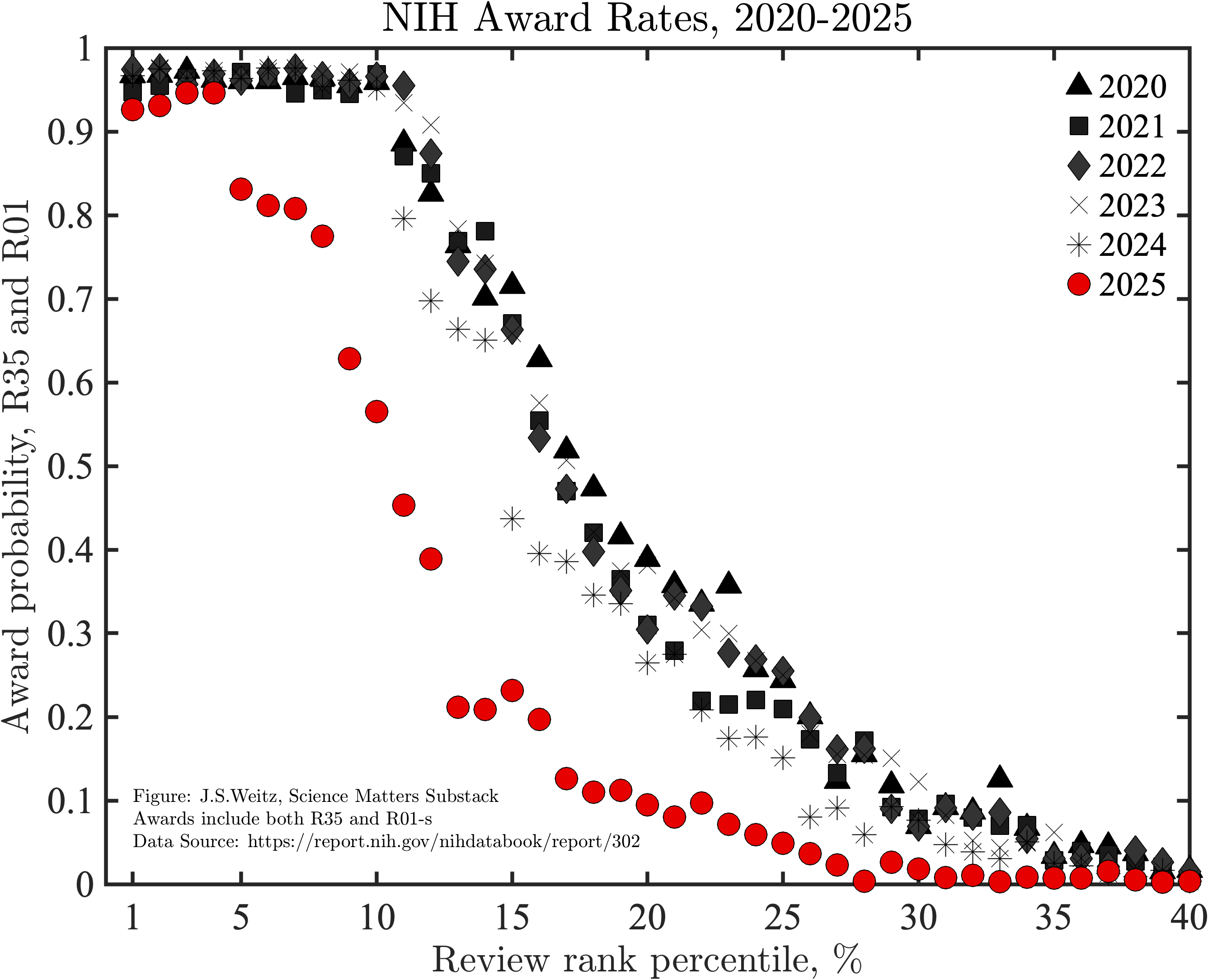
The graph shows the probability that a grant will be funded as a function of the review rank percentile. For insiders and practicing scientists, this plot is profoundly troubling. For those unfamiliar with the nuances of NIH reviewing – the data shows evidence of a significant, downward shift in award rates in 2025 for highly reviewed grants leading to fewer awards, less science, and a pending crisis in biomedical research. This post unpacks the interpretation, key causes, and likely consequences of this failure by NIH to commit to fund highly reviewed research proposals.
Falling rates of NIH awards for highly reviewed proposals
NIH grants are extremely competitive. Scientists work for years to assemble data and a research plan for consideration by panels of independent experts who assess the significance and feasibility of the proposed work. Each panel provides written comments and numerical scores. These numerical scores are then ranked. Typically, the bottom half of submissions are ‘Not Discussed’ by the panel. The remaining proposals are then discussed systematically and scored again. These scores are then ranked and given a percentile. The percentile represents how well each grant scored relative to other high-quality proposals, e.g., a 2% rank means that the grant scored higher than 98% of other grants and a 15% rank means that the grant scored higher than 85% of other grants, etc.
Although individual Institutes work slightly differently, there is a de facto, strong relationship between the NIH percentile score and the probability that proposal will be funded (a long-standing issue relevant to funding decisions that has drawn the attention of NIH watchers and insiders, including Jeremy Berg – former NIGMS Director). For the past few years, researchers understood their work was almost certain to receive an award notice if they scored in the top 10% of grants. Even percentile scores in the gray area between 10%-20% stood a decent chance – and some Institutes had even greater flexibility. No longer. The plot reveals a significant shift in the probability of funding in 2025 vs. the past five years (2020-2024).
As was widely discussed just weeks ago, Congress passed an omnibus bill that committed funding for extramural research grants in FY 2026 similar to the budget levels in FY2025 and FY2024. Despite a nearly flat budget, the realized number of awarded NIH research grants has dropped off significantly since the start of 2025. This drop off is especially evident when measured in terms of “R01” equivalents. These R01 equivalents represent NIH’s core funding mechanism for investigator-initiated science. Typical awards are 4-5 years and include a sustained investment of $1M and more to laboratories.
According to its own reporting data, in FY 2024 NIH awarded 7,720 R01 equivalent awards compared to 5,885 in FY 2025. The steep drop reflects, in part, the decision by HHS leadership and OMB Director Vought to implement ‘multi-year funding’.
The curse of multi-year funding
Multi-year funding sounds good.
In theory, and if implemented in good faith, and with a contingency plan to temporarily increase budgets, such a funding scheme could have led to more science. But the implementation was not done in good faith and did not come with an increased budget.
Multi-year funding means that the same budget is apportioned to fewer grants. In past years, most NIH grants were renewed annually as a strictly administrative manner. As an example, NIH could support 5 grants for funding, each at $400,000 in total costs per year for 5 years, and allocate $2 million annually in the first and subsequent years. With multi-year funding, NIH nominally distributes $2 million to a single investigator at once, even if that grant lasts over 5 years and won’t be spent in the first year. In this new framework, NIH views the money has having been spent (or at least allocated). The other highly reviewed grants? They are now out of luck. Each time NIH issues a multi-year award without boosting the total budget they are, in effect, reducing the amount of research dollars going to science and scientists. This decision reduces the number of awards and, as can be seen in the graph in this post, significantly reduces the chances that a highly reviewed proposal will be funded.
Scientists know this in their bones.
Not funding highly awarded grants is a recipe for ruining science, projects, careers, and the biomedical research pipeline. Securing an NIH R01 and building out an expert-staffed team can make the difference to starting a laboratory, helping an early career investigator secure tenure, and ensuring that experienced investigators continue to sustain innovative science. In the near-term, each $1 investment in NIH yields $2.56 in economic activity. In the long term, cutting back NIH’s portfolio will limit discoveries into life-saving drugs and therapies. Last year, a group of economists posed a counterfactual analysis to address the question “What if NIH had been 40% smaller?” in line with the White House’s proposed FY 2026 budget –such a scenario is likely to substantially decrease new drug approvals (as but one, crucial consequence).
Yes, the FY2026 budget passed, but multiyear funding continues to be one of multiple factors leading to reduced award rates. In effect, the White House quietly downsized NIH’s extramural program by over 20% last year, consistent with similar cuts to NIH’s staff in its intramural program. Similar levels of multiyear funding were written into the FY2026 budget approved by Congress. Even now, HHS continues to reject highly ranked proposals that are shovel ready; left unchecked such declines will lead to the dismantling of American leadership in science and medical research.
Situational and rhetorical readiness
The substantial reduction in award rates represents just part of the story.
The reduction in new awards is part of a portfolio of lost science arising as a result of terminations, freezes, stalled payments, and award delays. The ongoing collapse in award rates will lead to job losses, gaps in research programs, and drive scientists to spend more time writing grants rather than doing science.
The data also reinforce a message: American leadership in science and medical research requires far more than getting across the finish line in top-line budget negotiations and will require continued vigilance to track how HHS treats applications and existing awards.
NIH research awards provide the stability for investigators to take risks, employ experts on staff, and invest in complex experiments, population studies, and computational models that drive health innovation and discovery. There are many reasons to have a substantive policy debate on the best way to utilize information from study sections in shaping award decisions. Panels are not perfect, neither are program officers. In theory, moving away from strict paylines can have benefits and enable structured decision making. But, be careful what you wish for: if decisions are taken away from expert panelists, there is a genuine risk they will be handed over to an opaque internal process with mandates from HHS leadership to align awards with administration priorities or forgo awards altogether.
In a recent, widely disseminated podcast, the hosts of “Why Should I Trust You” interviewed NIH Director Bhattacharya. About 20 minutes into the hour-long discussion, the hosts asked Bhattacharya to clarify his prior statements on the state of NIH funding via the seemingly anodyne question: “[H]elp us understand what exactly do you mean when you say there haven’t been any funding cuts?”
Bhattacharya:
“I mean literally, there have not been any funding cuts. Literally, the case that the NIH budget was, I think, like 48 something like $48 billion in 2025 you know that is passed by the previous Congress, and the budget passed for 2026 is about 48, 49, $50 billion dollars increase in spend, in spending allocated to the NIH by by the government. And so there has literally, it’s literally the case that there’s been no funding cuts, and yet you have this widespread reporting by the news media that there’s cuts. It makes absolutely no sense. It’s, I mean, it’s literally fake news.”
The repeated use of the word ‘literally’ and appeal to ‘fake news’ is revealing (as is the extended back and forth) – especially with the facts at hand.
NIH’s data reporting provides granular insights into a reduced research portfolio. In 2025, NIH terminated thousands of grants worth billions of dollars. HHS issued grant terminations that impacted more than 74,000 clinical trial participants. HHS and OMB decisions slowed the progress of new science and reduced funding “R01” investigator-initiated science by more than 20% despite having a nearly flat budget.
Ongoing policy decisions come with consequences, as the graph that started this piece makes clear. Repairing the damage cannot wait: it requires scientists, advocates, the public, and policymakers confront the accumulating gap between America’s capacity to fund innovative science and medical research and the diminished and narrowed vision of what is possible preferred by this administration.
This is a mess. Another element that is often lost on people is the positive impact that researchers receiving new NIH grants have on simply keeping people employed. Efficiency on teams is great, but hiring a research manager or a postdoc also means that the local businesses will have new patrons.
The scientific loss is harder to feel for everyday people immediately, but job loss and hollowing out cities who built up infrastructure to do really cool work is felt quickly.
Is it my perception that they invented a virtual third axis to your plot that is the actual appropriation for the CURRENT fiscal year of the multi-year awards? That is, the comparison to the previous years should be on a current FY basis.